

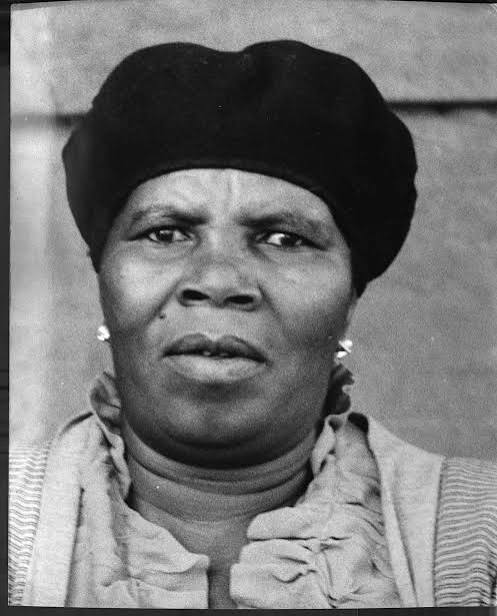
Annie Silinga. Image: Facebook.
CAPE TOWN, South Africa — Annie Silinga remains a hidden stalwart of the Struggle for Freedom in South Africa.
A prominent anti-pass laws and anti-apartheid political activist, Mama Silinga famously declared: “I will never carry a pass.”
The pass laws were a system of internal passport controls in South Africa and colonial Namibia (then South West Africa) designed to racially segregate the population, restrict the movement of Black, Indian, and Coloured people, and control the supply of cheap migrant labor. Mama Silinga was repeatedly jailed for her steadfast refusal to carry one.
She is widely remembered for her role as President of the Cape Town African National Congress Women’s League (ANCWL), her leadership in the historic 1956 anti-pass Women’s March to the Union Buildings in Pretoria, and for being the only African woman from the Western Cape indicted in the 1956 Treason Trial.
Early Life and Move to Cape Town
Mama Silinga was born in 1910 at Nqamakwe in the Butterworth district of the Transkei (now part of the Eastern Cape). Historical records show she completed only a few years of primary school.
For 27 years, Mama Silinga lived in her native region, where she worked in the mines. She grew up in Transkei during a period of relative prosperity when the land yielded crops and cattle grazed freely. However, overpopulation gradually led to severe soil erosion and overgrazing, triggering widespread poverty in the area.
By 1937, conditions had deteriorated to the point where Mama Silinga felt compelled to move. Her “babies,” she later recalled, “had been dying in the Transkei.”
That same year, at age 27, she relocated to Cape Town, where her husband, Matthew, had just secured employment, hoping also to access better medical facilities. In Cape Town, for the first time, Mama Silinga, her husband, and their five children could live together under one roof. At Matthew’s previous job in the Johannesburg mines, housing was not provided for mineworkers’ families, and strict regulations prohibited women from staying for extended periods.
After World War II, in 1945, Mama Silinga and her family moved to Langa township, where she began attending community meetings focused on improving local living conditions. Although she faced numerous arrests over the decades, she and her family remained in Langa, where she lived for the rest of her life until her death in 1984.
Political Awakening and Grassroots Leadership
In 1948, at the age of 38, Silinga joined the Langa Vigilance Association (LVA), an organization dedicated to fighting for better living conditions in Langa and protecting residents from oppressive apartheid laws.
In 1952, she joined the African National Congress (ANC). Shortly after joining, she helped organize more than six months of civil disobedience against the National Party government as part of the 1952 Defiance Campaign. Silinga participated directly in anti-pass actions, leading to her arrest and a brief prison sentence—which she served while caring for her six-month-old baby.
In 1953, as a member of the ANCWL, Mama Silinga joined the core group that organized the founding meeting of the Federation of South African Women (FEDSAW) to rally women against the extension of pass laws. Led by communist and trade unionist Ray Alexander, the organizing committee included Gladys Smith of the Cape Housewives’ League, Katie White of the Women’s Food Committee, and Dora Tamana of the ANCWL and the Communist Party of South Africa.
At FEDSAW’s inaugural conference in Johannesburg in April 1954, Mama Silinga was elected to the National Executive Committee. It was during this historic conference that women across diverse racial backgrounds jointly drafted the landmark Women’s Charter.
Later in 1954, during a FEDSAW meeting at the Grand Parade in Cape Town, Silinga made her famous declaration:
“I will never carry a pass. I will only carry one similar to Mrs. [Susan] Strijdom’s. She is a woman and I am too. There is no difference.”
Banishment, the Treason Trial, and Later Years
After defying the pass laws and exhausting several unsuccessful legal appeals, Mama Silinga was banished under police escort to the Transkei in 1956. She promptly returned to Langa illegally to rejoin her husband and children. In 1957, she successfully appealed her banishment on the grounds that more than 15 years of continuous residence in Cape Town legally entitled her to stay.
On August 9, 1956, Silinga helped lead 20,000 women organized by FEDSAW in their march to the Union Buildings in Pretoria to deliver anti-pass petitions to the Prime Minister.
In the repression that followed, Mama Silinga was arrested alongside FEDSAW leaders Lilian Ngoyi and Helen Joseph, as well as ANC leaders Oliver Tambo and Nelson Mandela. The apartheid regime charged Silinga and 156 other activists with high treason. Among those arrested, she was the only African woman from the Western Cape. The initial preparatory examination lasted until December 1957, when the state dropped charges against 61 defendants, including Silinga.
In 1958, Silinga was elected President of the Cape Town ANCWL. Following the 1960 anti-pass protests and massacres in Langa and Sharpeville, the apartheid government declared a State of Emergency and banned the ANC. Silinga was arrested once again. Upon her release, she contributed to forming the Women’s Front and was named a patron of the United Democratic Front (UDF) upon its launch in 1983.
Legacy and Tributes
Mama Silinga passed away in 1984 without ever having carried an apartheid pass.
Though she was initially buried in an unmarked pauper’s grave, artist Sue Williamson—at the request of Annie Silinga’s family—created a special grave marker in Langa Cemetery inscribed with her battle cry: “I will never carry a pass!”
In addition to her political resistance, Silinga is remembered for her deep care for her community, having started a crèche alongside Winnie Seqwana in Langa. In honor of her contributions, a street in Philippi, Cape Town, bears her name today.
Artist Tina Ramos Ekongo included Silinga in a portrait collection celebrating anti-apartheid leaders, describing her legacy:
“She was one of the leaders in the anti-pass campaign in apartheid South Africa who fought for better living conditions for her family and her country. Her kindness and caring nature stood out as important characteristics, often overlooked as political qualities. That she achieved this with only a few years of primary education is all the more remarkable.”

